The analyses and opinions presented on Career Cloud are our own. We may receive commissions from purchases made after visiting links within our content. Learn More.

So you’re about to craft your resume, and you know what you’ve done, but how are you supposed to quantify your experience and highlight all your pertinent skills on a single piece of paper? Anyone can list their skills, but listing the right skills is what’s important. The skills section of your resume is your chance to showcase how you can excel at the position you’re applying to, and in this article, we’re going to show you exactly how. But it’s not as simple as it sounds.
There are both hard skills and soft skills, which we’ll explore in this article. There are endless variables that will determine what types of skills you will list for any given job and we’ll get into the specifics of those, as well. People go crazy trying to decide what to list and what to leave out. There is so much to add, yet so little space, and we hope this article will help you to decide which skills to include and which ones to leave out.
If your resume needs help, our friends at TopResume offer a free resume review! Their free review evaluates the style and organization of your resume, the writing, and mechanics of your resume and an applicant tracking system (ATS) analysis.

Hard Skills vs. Soft Skills
There are two types of skill sets to list on your resume: hard skills and soft skills. Hard skills are skills that you have acquired through experience and training that are specific to a certain job. Not everyone possesses these. Soft skills are skills that anyone can possess that enable you to complete the job. Think of communication, teamwork, and critical thinking. In other words, hard skills are what you can do and soft skills are how you can do them.
Now that you know the difference you may think that employers place more emphasis on hard skills, but this simply isn’t the case. More emphasis is being placed on soft skills, especially for entry-level employment. If everything is equal, an employer will choose the candidate with better soft skills, which usually bleeds through in the interview process.
Soft Skills
If you think you’re qualified for the job it means you’ve got enough hard skills to be successful. Listing the soft skills is a bit more tricky because it depends on the culture at the company and the position, or even department, that you will be in.
Source: naceweb.org
Looking at the examples above, what skills do you possess or excel at that are pertinent to the job description? What do you think the hiring manager or applicant tracking system (ATS) is looking for?
According to naceweb.org, the bolded attributes are the most sought after.
You should try and learn the job description as much as possible so you can match it with your resume. An absolute home run in a job interview would be drawing on the requirements in the posting and giving examples of how you’ve successfully completed those requirements in the past. This would highlight both hard skills and soft skills if executed correctly.
Related: How To List Communication Skills On Your Resume
Hard Skills
The hard skills are a bit simpler and you will know whether or not you’re qualified within the first few seconds of reading a job description. If you are qualified, it’s time to go back to your resume and make sure it’s in sync with what’s on the job posting.
Examples of hard skills could be:
-
A lifeguard who is certified in CPR
-
A translator who is fluent in more than one language
-
A sales associate who has used Salesforce
This is merely scratching the surface of literally thousands of job qualifications, so remember… every job is different and it is up to you to make sure that you list the coinciding skills on your resume so you can be selected for an interview. Below are examples of hard skill sets in some of the most common types of employment that people search for.
Here is an example of a job description so you can decipher the difference between hard and soft skills, and how you might apply them to your resume.
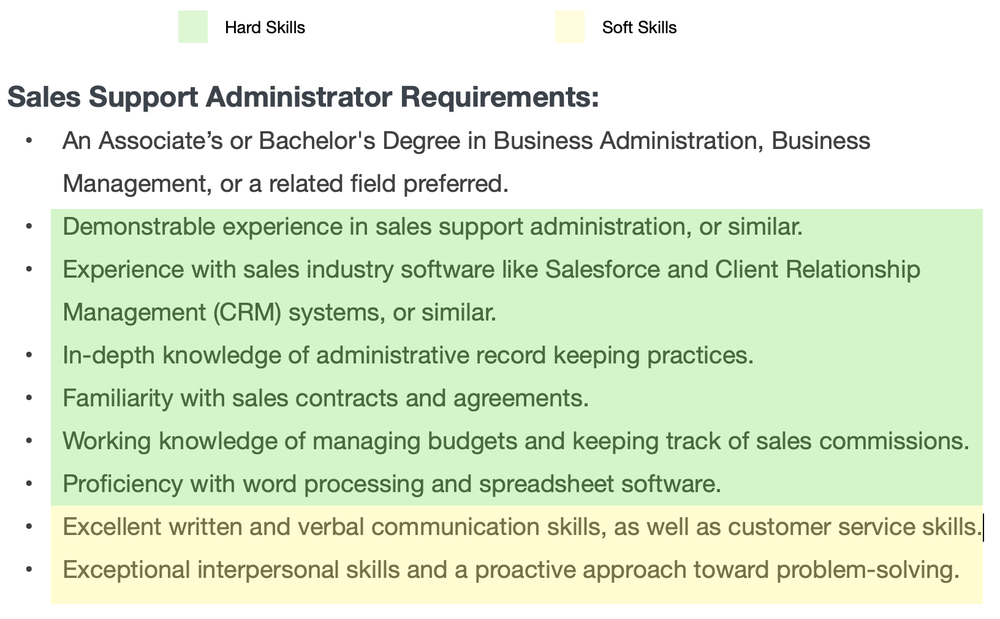
So the skills you’d list would be:
-
Salesforce
-
Written and verbal communications
-
Administrative record keeping
-
Budget management
-
Problem-solving
-
Word and Excel
Even though this seems simple after the example is written out, you’d be surprised at how many people don’t list the necessary skills. As we stated above, every job and company is different, and taking the time to tweak each resume to match the description will put you leaps and bounds ahead of those who don’t.
Choosing Additional Skills
While pulling skills from the job description is a good start, it’s not enough. The additional skills that you list may, in fact, be the difference in separating you from other candidates, and there are three ways to go about doing this.
-
Ask yourself “What do I really enjoy doing?” And then try and list as hard or soft skill(s). If there is something that you enjoy doing, you’re probably pretty good at it, and it could very well be an asset to the employer even though that specific skill is not listed in the job description.
-
If you possess a skill that you think is pertinent to the position or company you should without a doubt list it. Coding platforms or foreign language proficiency are good examples of this.
-
If you know you’ve got additional skills, but are having trouble deciding which ones to add, try scheduling an informational interview. This is a great way to introduce yourself to the company, learn more about the position, and give you ideas for additional skills to add.
What NOT to Include in Your Skills Section
Now that we’ve reviewed the best skills to include on your resume, let’s talk about the things you should leave out. Yes, you read that right. While you may adhere to the philosophy that more is better, recruiters and hiring managers aren’t likely to agree. To them, it’s more about quality rather than quantity. Once you realize that you only have about six seconds to capture their attention, you can see that it’s a good idea to pare down your skills section and highlight only those that are pertinent.
To put it another way, your resume is only as strong as its weakest link. Listing skills that are irrelevant, exaggerated, unproven or just plain fluff will probably do more harm than good. So what, exactly, are the types of skills to leave out of your resume? Take a look at this list we’ve compiled for some great examples:
Basic Computer Skills
It’s pretty much a given that these days everybody is adept at basic computer skills like email and Microsoft Word. So why make a point of adding them? Not only are these skills expected among employers, they won’t differentiate you from the competition. In fact, they’ll probably just be considered fluff. Instead of giving you an advantage, they’ll make it appear that you’re grasping for anything you can to make yourself look better because you don’t have the skills that actually are relevant.
Keep in mind, however, that there could be one exception. That is, if you have honed and perfected a very specific practice using those programs – like creating a database from scratch and importing data from Excel and other databases. A top computer skill like that would definitely be worth mentioning.
Social Media You’ve Only Used at a Personal Level
You may think it’s great that you have thousands of Twitter followers, a boatload of Facebook friends, and tons of Instagram likes. On a personal level, that is notable. But successfully managing your own personal brand is not the same as managing a company’s brand. In a professional setting, you’ll need more than the know-how to post engaging content and pictures of your friends, or even news about your current company. More than likely, a social media position will require knowledge in data analysis and experience with paid media, among other skills. So unless you possess significant skills like these that are necessary to do the job, leave them out.
Proficiency in Outdated or Obsolete Technology
More than ever, companies are seeking sophisticated, flexible professionals who understand technology. We all know that the software and technology used in a workplace can change in the blink of an eye. That makes it vitally important to stay on top of changes – or risk being unable to keep up. If you list technology that’s outdated among your skills – like out-of-use coding languages and old versions of software programs, for example – employers will automatically assume that your skillset is stale and your learning curve will be steep. To be competitive in the marketplace, they will always prefer employees who have demonstrated the ability to learn quickly. So skip the boast about knowing how to backup files on a floppy disk. Being savvy in outdated tech is not a plus.
Minimal Knowledge of a Foreign Language
News flash! Taking a few years of a foreign language in high school probably doesn’t qualify you as fluent. Even if you have an intermediate understanding of a language, if you can’t hold a conversation with native speakers, effortlessly read it, or conduct business in the language, it doesn’t belong on your resume. Imagine your chances of landing the job if your interviewer is fluent and tries to engage you in a conversation – and you can only respond with a blank stare. Not only will you appear incompetent, but you’ll also be considered a liar. At that point, the odds are high that you won’t be moving on in the interview process.
Exaggerations, Embellishments, and Lies
It’s not necessary to have every single skill listed in a job description. Generally, if you can match 80 to 90 percent of them, you should go ahead and confidently apply. What you shouldn’t do is sprinkle keywords from the description into your resume if you don’t actually possess the skills. Saying you can do something when you really can’t, just for the sake of mirroring the language you see, will eventually come back to bite you. So keep it real.
Irrelevant or Joke Skills
You may come across a hiring manager or two who think it’s funny or cute when you include skills that are irrelevant to the job. Like expert-level nacho maker or Lake Wakalaka snorkeling champ. Surprisingly, there are people who still do that and believe it will improve their chances of landing a job. But since you have no idea what your interviewer will or will not appreciate, we recommend that you leave the funny stuff out and always opt for professionalism on your resume.
General and Overused Buzzwords
It’s important to be careful with the skills you list, making sure they are appropriate to the specific job description. But did you know that how you word those skills and weave them into your resume is just as important. Applicants often make the mistake of using superfluous terms, like “results-driven,” for example, without providing the factual basis to back them up. Most hiring managers are tired of seeing the usual buzzwords over and over, which, when you think about it, don’t mean a thing. As much as possible, avoid using them in describing your skills and opt for alternate, more dynamic terms that better describe your abilities. Powerful action verbs are what will sell your potential – words like “streamlined,” “orchestrated,” and “boosted”, to name a few. Here are some of those mega-overused skill words that really don’t belong on your resume:
-
Specialize
-
Experienced
-
Skilled
-
Leadership
-
Passionate
-
Expert
-
Motivated
-
Creative
-
Strategic
-
Focused
Other Misused Words
Beware of getting too wordy in your resume’s skill section. Even if you feel like it’s a bit short, avoid getting flowery with language to stretch it out. For example, why say something like “owing to the fact” when the word “because” will do the trick. Also stay away from business jargon and cliches like “synergize” or “outside the box.” Be thoughtful and meticulous, but also be clear and concise.
Make Your Skills Look Exciting
The goal of any resume is to make obvious what potential problems you can solve for the employer. It follows then, that the key to accomplishing this is to make your specific problem-solving skills crystal clear. And exciting. And absolutely a perfect fit for the job.
Remember, you want the skills section of your resume to support the position described while reflecting your expertise in that particular arena. Most applicants will highlight between five and ten main skills. It’s also ok to include links to your work, such as blog posts. Attention is everything in a job search so it’s good to put out there as much relevant information as possible.
Focusing your skills on the strengths that will help you stand out is what you should always aim to do. For example, let’s say you’re a social media whiz applying for a branding role. Instead of stating the obvious – how a company can strengthen its brand via Twitter, Facebook, Instagram, and LinkedIn – let the hiring manager know you can adapt to changing social media landscapes by continually developing and enhancing online presence with creative strategies. In a single well-crafted sentence like this, you will demonstrate that you’re on top of your game with the skills to quickly respond and adapt to changes in the field.
To sum it all up, put your most important, most impressive capabilities out there. And make sure they are relevant to the job you want. It’s always obvious when something is thrown in just for the sake of… well, throwing it in. If you fail to make a connection, you can bet the hiring manager isn’t going to spend time trying to piece together the puzzle you’ve created.
Grab the Recruiter’s Attention with Keywords
One of the most important jobs of your resume is to quickly catch the eye of the hiring manager. How you do this is by strategically and smartly inserting keywords. Of course, the question is, “How do I know what keywords to use?” It’s really not that hard. Simply read through the job description and write down all the words that stand out to you. These are the keywords – the words a hiring manager will notice, the words that will speak to his needs, and the ones you should work into your skills section. Keep in mind that the job description will contain industry-specific words that you should incorporate, as well as words targeted to the required skills. When you have selected all the keywords, you should be able to determine the particular skills that are “must-haves” to make you the right candidate for the job. Then be sure to include them.
Keywords can be a little tricky because you have to select words that are relevant to your goals, as well as to the position you’re applying for. Similarly, different keywords will appeal to different hiring managers. But if you use the job description to identify the right keywords, you’ll craft a skills section that’s attention-grabbing, effective, pertinent, and downright stellar.
Break Through the ATS Barrier
Having an entire section of your resume devoted to skills makes a lot of sense. After all, your skills are what will make you useful to a company. Highlighting the right skills, in the right way, helps an employer quickly assess if you are the right person to fill their needs.
One thing to keep in mind, however, is that your resume isn’t always for human eyes only. The sheer volume of applications often makes it nearly impossible to review every single resume that is submitted. That’s why most larger companies today use an applicant tracking system (ATS) to help whittle the field down to the strongest candidates. And weed out the weakest. While this is an efficient time-saver for the companies, it also means that many resumes – in fact, most – never make it to a human recipient. But don’t fret. The skills section of your resume can help you break through this ATS barrier.
The main way an ATS flags a resume is by scanning it for relevant keywords. As we’ve already discussed, a well-constructed skills section will contain a large number of keywords relevant to a particular job. Once these are picked up by the ATS, your resume will receive the green light and you’ll be one step closer to being invited for a job interview.
How to Format Your Skills Section
Whether you’re looking to catch a hiring manager’s eye or come out on top in an ATS, your number one priority should be incorporating a skills section into your resume that shows off what you can do. The way you choose to format this important component is up to you, and, fortunately, there are options to help ensure you can pick one that works best for you, your style, and the job you’re going after. The following are four examples we think you will find helpful.
-
Develop a Simple Bullet List
This is the most straightforward way to highlight your skills. Insert the list right after your contact information and summary statement. By hitting all the key job requirements this way, you’ll not only capture a recruiter’s attention, but will rank high in a keyword search within an ATS. But don’t stop there; be sure to add context for every skill elsewhere in your work experience. It doesn’t matter that you have a skill if you can’t back it up by communicating how and where you’ve applied it.
-
Create a List with Expanded Bullets
You can add context by expanding the bullet points in your skills section to include further detail. This approach will offer more impact than simply highlighting your skills. However, it will also take up more space at the top of your resume. So consider trimming down the bullet list to four or five of your most relevant skills, and then work the remaining skills into your work experience.
-
List Additional Skills After Each Job
Use this option if you prefer a reverse chronological format for your resume. It will allow you to add shorter skill lists to each work experience. It’s important to note that fitting all your skills into a bigger text block might make things a little awkward for the reader. On the other hand, leaving them out could make the descriptions too vague. Our best recommendation is to work some hard skills into your work experience and to list others afterward. This will make your experience easier to read while still covering all your bases.
-
Break Your Skills Section into Categories
Are you applying for a role that requires a broad skill set? If your work history fits the bill, consider categorizing your skills into multiple lists. This often is a good method for people who are transitioning into management roles and need to demonstrate that they can work with individuals from a variety of disciplines. Segmenting your skill lists is a great way to showcase applicable skills, such as technical savvy and soft leadership skills. Plus, going a step further, you can even combine bullet points into a single section to better categorize skills.
Show Employers Your Best Self And Get the Job!
The skills section of your resume shows potential employers that you have the capabilities they need for the job they’re looking to fill. It’s where you match your skills with the job description they’ve provided and clearly demonstrate that you are a whiz with those abilities. Employers rely strongly on the information in a skills section and often use it to determine how far along you will advance in the hiring process. If you are ultimately offered the job, a strong skills section can even influence the salary they offer.
As a job hunter today, you’ll be coming up against some pretty fierce competition. Because hiring managers or an ATS may receive thousands of applications, it’s not enough to merely list a standard set of skills. You need a resume that’s carefully crafted and tailored to the specific position you’re applying for. And makes you stand out from the rest. So make sure the skills you report are relevant to the position, be specific on how you’ve successfully used them, and how you will apply them to excel at the company. If you shine on your resume, it’s safe to say employers will be confident that you will also shine in the job.
If you need additional help with your resume, our team recently reviewed the top resume writing services. Many of these services offer free resume reviews to get you started.